Behind The Chosen Chapter Seven: Terreiros, Orixás & Survival
Rio de Janeiro, 1951. A family rebuilding after a storm, twenty-seven households sharing sacred ground, a Catholic mother, a babalorixá, and a two-year-old girl speaking to somebody nobody else can see.
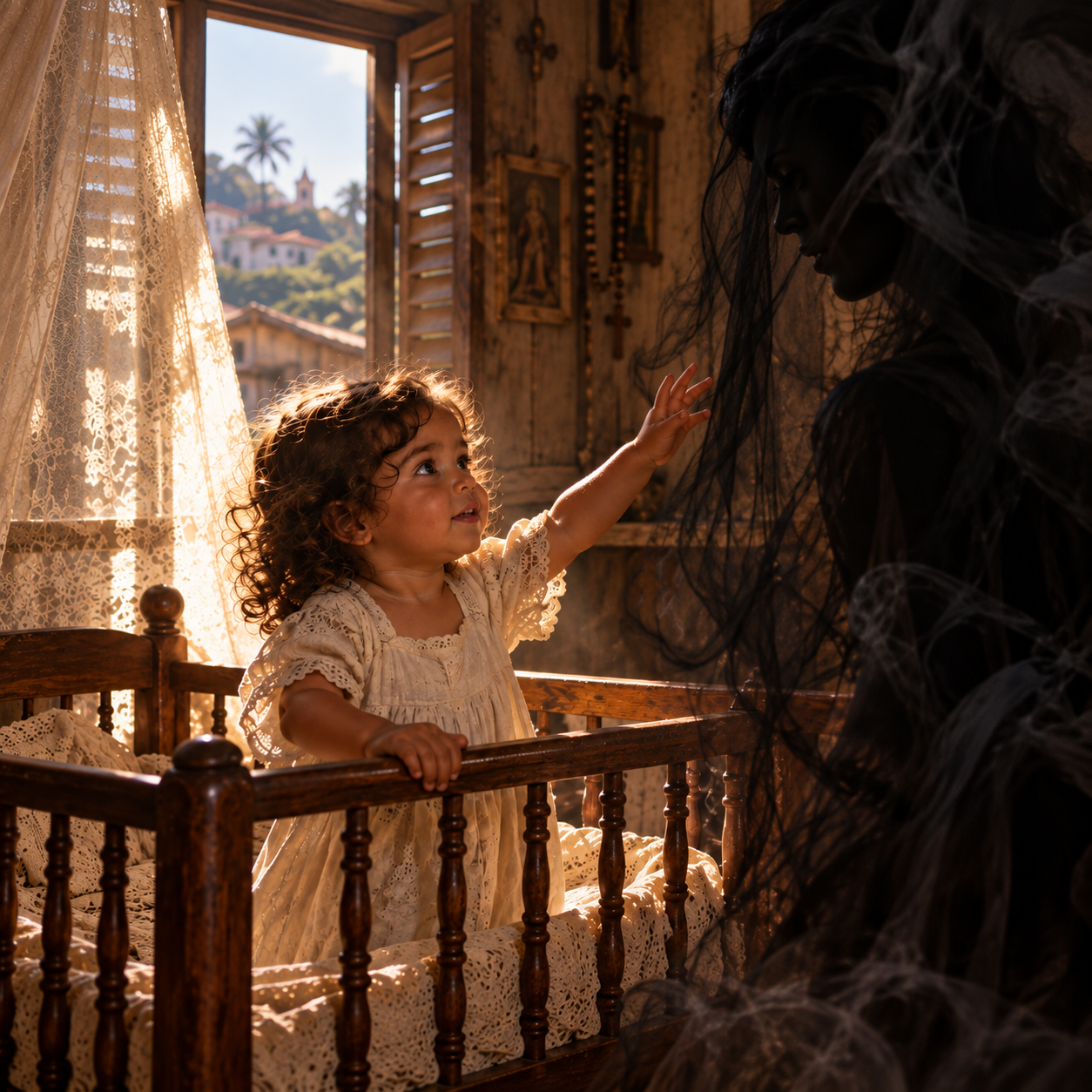
Chapter Seven of Lupe Farkas’s The Chosen returns to Rio de Janeiro in 1951, two years after the storm that changed the life of the do Nascimento family.
Carlos, Jacinta and their seven children have lost their house. They remain on the sacred grounds of the temple, and they are not alone. Other families have lost homes too. Wooden houses appear. Food is grown. Children are taught. People begin rebuilding together.
To someone unfamiliar with Afro-Brazilian religions, that might sound like something invented to make a supernatural novel more dramatic.
The supernatural part is coming.
The community part has very real roots.
First, what exactly is a terreiro?
The easiest English translation is temple.
It is also not quite enough.
A terreiro is a sacred religious space associated with Afro-Brazilian traditions including Candomblé and Umbanda. Depending on the house, its lineage and its physical location, the terreiro may contain spaces for ceremonies, shrines, kitchens, plants, sacred trees, courtyards, houses and areas used by the religious community.
It does not have to mean one building with a door and an altar inside.
It can mean an entire piece of sacred ground.
That distinction matters in Chapter Seven because Carlos does not merely believe that he lives next to his religion.
He lives inside it.
The soil is sacred. The water matters. The trees matter. The houses matter. The people matter.
Why would families be living there?
This is one of the details underneath Chapter Seven that deserves more attention than it initially appears to need.
Terreiros have historically been more than places where people arrive for a ceremony and leave when it finishes.
Brazilian research has documented terreiros as spaces of acolhimento — welcome, care and receiving people — as well as places of mutual assistance, the preservation of knowledge, material help and community support.
That does not mean every terreiro in Brazil functions in exactly the same way, nor does it mean every religious leader operates an emergency housing programme.
There is no Afro-Brazilian Vatican issuing an instruction manual for every house in the country.
But the idea that a religious community would open its space when people are hungry, displaced, frightened or in need is absolutely at home within this history.
Some contemporary terreiros explicitly describe spiritual assistance as being offered not only to members of the house but to people who arrive there looking for help.
Religion and community care have often existed side by side.
The terreiro is sacred ground. But sacred ground is still full of people who need feeding, protecting and occasionally somewhere to sleep.
The babalorixá is responsible for more than ritual
Carlos is the babalorixá of the community in Chapter Seven.
The term refers to a male religious leader or priest within Candomblé traditions. The corresponding female title is commonly ialorixá.
But reducing the role to “the man who performs ceremonies” misses what religious leadership can mean inside a terreiro.
The leader carries knowledge, ritual responsibilities and authority within the house. That leadership may also make the babalorixá a central figure in the social life of the community around him.
Which explains Carlos.
After the storm, he does not look at twenty-seven families and see twenty-seven separate problems.
He sees his community.
And when Jacinta demands that he rebuild their old house and leave, Carlos cannot understand why she would want to abandon what, to him, has already become home.
From slavery to quilombos: the older history underneath the scene
This is where we need to make an important distinction before the internet turns two different things into one.
A terreiro is not a quilombo.
Historically, quilombos were communities created in resistance to slavery and oppression. Enslaved people who escaped plantations and other systems of forced labour created settlements where Black communities could organise, defend themselves and build social and economic life outside the control of the slave system.
Palmares became the most famous example, but it was far from the only one.
Terreiros are religious communities.
So why discuss them together?
Because both belong to a much larger Brazilian history of Black people creating spaces where culture, memory, spirituality, knowledge and human life could survive systems designed to control or destroy them.
The connection is not that every terreiro descended directly from a quilombo or that they performed the same social function.
The connection is the older tradition of collective survival.
People protecting one another.
Knowledge being transmitted when official institutions did not protect that knowledge.
Food being shared.
Children being raised inside communities with their own memory and religious world.
A place to belong when the society outside the gate was often hostile.
That is the history sitting quietly underneath Carlos when he looks at his terreiro and tells Jacinta:
This is our house.
Candomblé and Umbanda are not the same religion
Chapter Seven also lives inside another part of Brazilian religious reality: the boundaries between religious traditions are real, but lived religion does not always behave as neatly as a textbook would like.
Candomblé
Candomblé developed in Brazil through African religious traditions carried across the Atlantic by enslaved people and their descendants.
Different Candomblé nations preserve different lineages and vocabularies, including traditions associated with Yoruba/Nagô, Jeje and Bantu peoples. Depending on the tradition, worship may centre on Orixás, Voduns or Nkisis.
Ritual knowledge, hierarchy, initiation, music, food, ancestry and sacred space all form part of an extraordinarily complex religious world.
Umbanda
Umbanda developed in Brazil during the twentieth century and brought together several currents within Brazilian religious life.
African-derived traditions are present, but so are influences associated with Catholicism, Spiritism and Indigenous cosmologies.
Many Umbanda traditions work with spiritual entities such as Caboclos and Pretos-Velhos, alongside relationships with the Orixás.
That alone makes it different from Candomblé.
Different does not mean disconnected.
And yes, some terreiros cross those boundaries
This is where reality becomes more interesting than the clean definitions.
Some houses identify clearly as Candomblé.
Some identify clearly as Umbanda.
Others contain practices associated with more than one tradition.
Modern official mapping in Brazil has recorded terreiros that practise both Candomblé and Umbanda, and heritage documentation has recognised houses where Candomblé and Umbanda practices exist together.
That does not mean that every practitioner approves of mixing traditions or that every terreiro works this way.
It means that the religious landscape is considerably more complicated than: this religion stops here and the next one begins three metres away.
People move.
Families move.
Religious leaders learn through particular lineages.
Communities change across generations.
Practices meet.
And in some houses, they remain together.
Where does Quimbanda fit?
Quimbanda is another tradition and should not be used as a fashionable synonym for “dark Umbanda.”
Nor is it another name for Candomblé.
It has its own histories, practices and interpretations.
However, there are religious houses and practitioners whose religious lives cross Umbanda, Candomblé and Quimbanda in different ways.
Again, there is no universal formula.
So when the world surrounding Carlos refuses to fit perfectly into one box, that is intentional.
Brazilian religion has never been particularly interested in making life easier for classification systems.
The Orixás Carlos names
When Carlos argues with Jacinta, he lists what the community has.
Fruit.
Vegetables.
Fish.
Fresh water.
Strong children.
To Jacinta, those things are simply part of daily life.
To Carlos, the sacred is already inside them.
Iemanjá
Iemanjá is one of the most recognised Orixás in Brazil and is deeply associated in Brazilian religious traditions with the sea and waters.
That relationship matters enormously for Carlos.
When he does not know what to do about Maria, he enters the sea.
He asks Iemanjá for clarity.
That is not simply Carlos taking a dramatic swim before making a decision.
The act places his body physically inside the religious world he trusts.
The water is not background scenery.
It is part of his relationship with the sacred.
Oxum
Oxum is strongly associated with fresh water, particularly rivers and flowing waters, as well as fertility, motherhood, beauty and abundance in many Brazilian traditions.
That is why her name appears when Carlos speaks about what sustains the community.
For him, saying that Oxum gives them fresh water is not a poetic metaphor.
He is describing reality according to his faith.
The same water Jacinta sees running through the land can be understood by Carlos as something sacred.
Exu returns
If you read the Suere reference article for Chapter Five, you already know that Exu entered The Chosen before Maria could even walk.
He returns in Chapter Seven.
In Candomblé, Exu is an Orixá closely connected with communication, mediation, movement, paths and exchange between worlds.
Brazilian cultural and public-health material describes Exu as a messenger, the figure who makes communication between human beings and the world of the Orixás possible.
And once again:
Exu is not the Christian devil.
Jacinta may believe that.
Carlos does not.
Those are character positions inside the novel, not Suere declaring one religion’s prejudice to be another religion’s theology.
Why does Carlos go to Exu?
Because his two-year-old daughter is talking to somebody nobody else can see.
A perfectly normal parenting problem.
Carlos does not immediately decide Maria is possessed.
He does not run from her.
He does not decide that whatever he cannot understand must be evil.
He enters the sea, seeks clarity and then sits with Exu.
He listens.
That sequence tells us almost everything we need to know about the difference between Carlos and Jacinta.
And Nossa Senhora Aparecida is still there
Jacinta has not stopped being Catholic because her house was destroyed.
Carlos knows this.
So he builds her a chapel.
He carves an image of Nossa Senhora Aparecida and makes sure there are flowers and candles on her altar.
This is one of my favourite details in Chapter Seven because Carlos does not need to believe exactly what Jacinta believes in order to respect what she loves.
The tragedy is that Jacinta has not yet learned to return the favour.
Catholicism and Afro-Brazilian religions have lived beside one another in Brazil for centuries, through histories that include coercion, survival, syncretism, shared families and genuine personal devotion.
Sometimes that coexistence is peaceful.
Sometimes it produces Carlos and Jacinta arguing in the middle of the sacred grounds while their supernatural toddler talks to a witch.
Carlos sees sacred ground. Jacinta sees danger. Twenty-seven families see somewhere they can begin again.
Then there is Zita
And this is where Suere leaves religious history and walks back into The Chosen.
Maria is two years old.
She barely speaks when adults are listening.
When she believes she is alone, that changes.
She speaks to a woman named Zita.
Nobody can see Zita.
At least, not in the way Maria does.
What happens next belongs completely to the fictional supernatural mythology of Lupe Farkas.
Zita, Maria’s ability to predict events, the unknown language she speaks, the reactions of the animals and weather, the invisible hand and the supernatural change in Maria’s hair belong to The Chosen. They are not presented as traditional practices, doctrines or claims about Candomblé, Umbanda or Quimbanda.
Why Chapter Seven needed all of this
The religious references are not there to decorate Maria’s childhood with something exotic.
They determine how every person in the chapter understands what is happening.
Jacinta interprets Maria through fear.
Carlos interprets her through responsibility.
The community interprets the terreiro as home.
And Maria appears to be interpreting a world nobody else can fully see.
The same piece of earth can therefore be a temple, a refuge, a school, a family home, a place of spiritual danger and a place of protection depending on who is standing on it.
That is exactly why the word terreiro matters.
Calling it simply a temple would be easier.
It would also make the world considerably smaller.
And The Chosen has enough problems without making Maria’s world smaller.
Read Chapter Seven on Lupe Farkas
Want the fictional story behind these references? Read The Chosen Chapter Seven: Zita and meet two-year-old Maria inside the community that rebuilt itself after the storm.
The references
Primary fictional text discussed in this reference article. Published 27 September 2026.
Read Chapter SevenAcademic discussion of terreiros as historical spaces of Black resistance, mutual assistance, preservation of traditional knowledge and community acolhimento.
SciELO BrasilHistorical overview of quilombos as organised communities of resistance to slavery and colonial oppression in Brazil.
Fundação Cultural PalmaresBrazilian cultural reference material on Candomblé, Orixás, sacred spaces and the terreiro as a religious environment.
CNFCPHeritage documentation recognising terreiros as spaces of acolhimento, identity, memory, resistance and community life, including a house integrating Candomblé and Umbanda practices.
Prefeitura de São PauloCultural heritage study discussing Candomblé and Umbanda and documenting terreiros that practise both traditions.
Secretaria de Cultura do Distrito FederalBrazilian public-health material produced with Afro-Brazilian religious communities, including Exu as messenger and mediator between the human world and the Orixás.
Biblioteca Virtual em SaúdeThe earlier Suere reference article explores Maria’s birth, Nossa Senhora Aparecida, Ogun, Exu and the religious world already surrounding the do Nascimento family before Chapter Seven.
Continue the Reference Library