Behind The Chosen Chapter Five: Exu, Ogun & Aparecida
Brazil, 1949. A Catholic woman, a husband who speaks with the deities, a violent storm, and a child who apparently had no intention of arriving quietly.
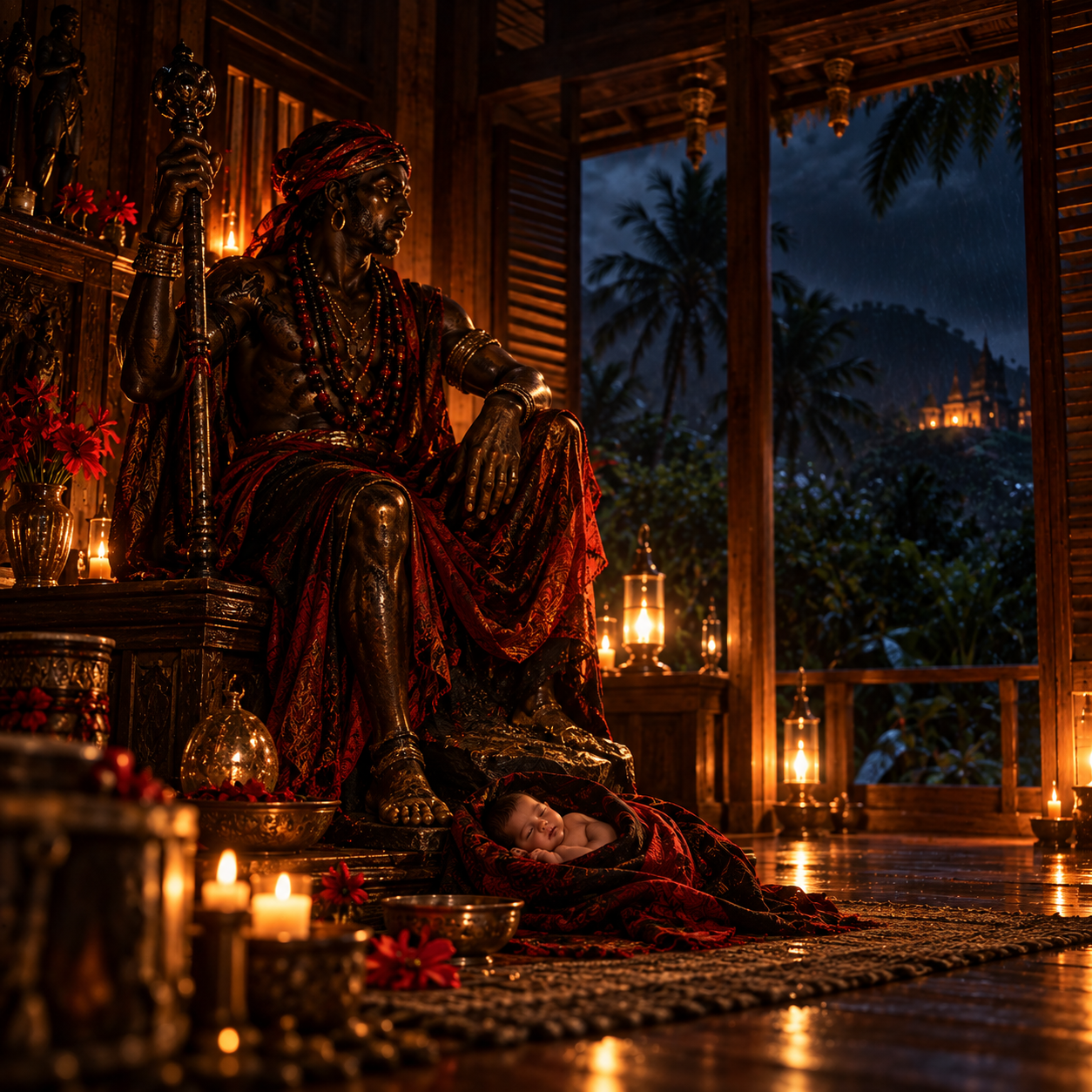
Chapter Five of Lupe Farkas’s serialized gothic horror The Chosen moves the story to Brazil in 1949 and drops us into a family where two religious worlds already share the same roof.
Jacinta do Nascimento believes in God, Jesus and Nossa Senhora Aparecida. Her husband Carlos speaks with the Orixás.
Neither of them seems particularly interested in becoming less stubborn about it.
Then Maria decides to be born.
Chapter Five works because it uses real Brazilian religious and cultural references, but it also knows exactly when to stop researching and start causing trouble with them.
Nossa Senhora Aparecida
Jacinta’s devotion is clear before the storm even begins.
Carlos tells her that the deities he consulted revealed two things: their seventh child would be a girl, and she did not belong to them.
Jacinta immediately gives the answer she wants. Perhaps the child belongs to the only true God. Perhaps to Nossa Senhora Aparecida. Perhaps she will become a nun.
Carlos, unsurprisingly, finds the nun theory hilarious.
But Jacinta’s devotion is not decorative Brazilian wallpaper. By 1949, Nossa Senhora Aparecida already held a powerful place in Brazilian Catholic life. That matters because when Jacinta begs for help while dragging herself up the hill in labour, she is calling on the religious figure she trusts most.
Which makes the building waiting at the top of that hill considerably less convenient.
Ogun, and the problem of Carlos
Carlos receives one of the most efficient descriptions in the chapter.
He is kind. He is patient. But he is a son of Ogun.
And once Carlos decides something, everyone else may as well conserve their energy.
Ogun, or Ogum in Portuguese usage, is strongly associated with iron, force, work, movement and the opening of paths. That does not mean every child of Ogun can be reduced to one tidy personality profile. Religion is not a BuzzFeed quiz.
But as character language, the reference works beautifully. Carlos decides they are leaving the coast. Carlos decides they are climbing the hill. Carlos decides his pregnant wife and six boys are reaching the temple before the storm reaches them.
And everybody climbs.
The research gives the story roots. The fiction is where the roots begin growing into places they probably should not.
Then we arrive at Exu
This is where Chapter Five walks directly into one of the most persistent misunderstandings surrounding Afro-Brazilian religions.
Jacinta sees Exu and thinks devil. Carlos does not.
That difference matters.
In Candomblé, Exu is an Orixá. Brazilian anthropological research has described him as messenger, mediator and a profoundly dynamic figure. The Christian identification of Exu with the devil belongs to a history of interpretation and prejudice. It is not a simple translation.
Exu is not Satan wearing Brazilian clothes.
Candomblé, Umbanda and Quimbanda are not the same thing
This deserves its own section because discussions about Afro-Brazilian religions have an annoying habit of throwing Candomblé, Umbanda and Quimbanda into one large mystical blender.
They are different religious traditions.
Even the word Exu cannot simply be moved from one tradition to another as though it always means exactly the same thing.
In Candomblé, Exu is an Orixá. In Umbanda and Quimbanda, traditions may also speak about Exus as spiritual entities, with theological positions and ritual treatments that differ from the Orixá Exu of Candomblé.
That complexity is exactly why treating Exu as a synonym for “devil” tells us much more about Christian interpretation than it tells us about Exu.
The house at the entrance
Chapter Five gives us another detail that looks like gothic staging until you start reading Brazilian sources.
The family reaches sacred ground during the storm. The first structure is not the main temple. It is the house of Exu.
It stands at the threshold, guarding the entrance and the way beyond it.
That placement has real parallels in Afro-Brazilian religious spaces, where Exu may occupy a position associated with the gate, the doorway or the beginning of passage.
So no, placing Exu at the threshold was not simply an author thinking, “This looks sufficiently ominous.”
Although, admittedly, it does.
Now we leave religion and enter The Chosen
This is the line the article needs to keep very clear.
Real religious references exist underneath the scene.
What follows belongs to the fictional supernatural mythology of The Chosen.
Carlos wraps Maria in Exu’s coat. Maria screams. The storm screams with her. He carries the newborn across the room and places her at Exu’s feet. Maria stops crying. At exactly the same moment, the storm stops.
Maria being wrapped in Exu’s coat, placed at his feet, and the storm stopping with her cry are elements of Lupe Farkas’s fictional world. They should not be read as descriptions of a traditional Candomblé, Umbanda or Quimbanda ritual.
That distinction matters.
Writers can use religious history, symbolism, architecture, language and belief as foundations. Then fiction starts building something else on top. Preferably something slightly disturbing.
“She does not belong to them.”
And then Chapter Five returns to the sentence that appeared before Maria was even born.
The deities would tell Carlos only two things. She was a girl. And she did not belong to them.
Jacinta interprets that through Catholicism. Perhaps Maria belongs to God.
Then Maria is born inside a house of Exu, wrapped in Exu’s coat, placed at his feet, and the entire storm apparently decides that this is enough drama for one evening.
Jacinta looks at Exu and tells him, “She’s yours only today.”
But the chapter immediately corrects her. Exu is only guarding Maria. She does not belong to him either.
And that is where the research stops being the most interesting part.
Because now the question is not which deity Maria belongs to.
Who chose her?
Read Chapter Five on Lupe Farkas
Want the full fictional scene behind these references? Read The Chosen Chapter Five: Maria on Lupe Farkas.
The references
Primary fictional text discussed in this article. Published 25 September 2026.
Read Chapter FiveBrazilian anthropological research on Exu, including his place in Candomblé and Umbanda and the transformations of his meanings in Brazil.
Universidade de São PauloResearch by Vagner Gonçalves da Silva on the history, mythology and Brazilian development of the worship of Exu.
Departamento de Antropologia, USPBrazilian documentation of Afro-Brazilian religious spaces, terreiros and the organization of sacred areas.
IPHANHistorical material relating to Nossa Senhora Aparecida, Brazilian devotion and her recognition as Patroness of Brazil.
Biblioteca Nacional Digital